|
To understand how renewable energy is an investment in energy independence, its important to understand the difference between capital expenditures (CapEx), operating expenses (OpEx) and Levelized Cost of Energy (LCoE).
CapEx
|
The cost of investment. It represents things like generation infrastructure including hydroelectric dams, solar panels, wind turbines, diesel generators, and transmission and distribution infrastructure, the powerlines, substations, and other things used to deliver power. How affordable a renewable energy project is is strongly influenced by the cost of the capital investment in that technology. While hydroelectric projects have the highest initial capital, they are also the longest lasting (50-100 years) and most reliable. As with all technologies, renewable energy sources have reached a point where the initial high capital investments made that them prohibitively expensive in many cases, are now gone and are comparable if not cheaper that fossil-fuel powered generation.
|
The price of EVs and renewable energy predicably falls as
their cumulative capacity or production doubles
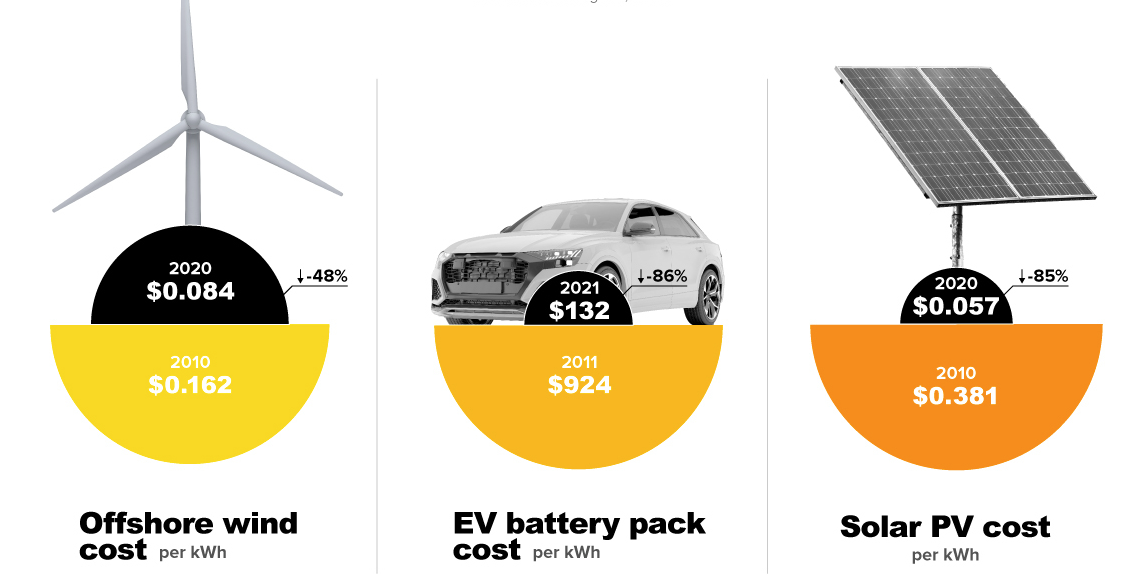 Graphic by Visual Capitalist, BloombergNEF, IRENA
 |
OpEx
|
The cost of doing business. Day-to-day costs of running a business. Examples include employee salaries, equipment maintenance, insurance, research and development, office supplies, rent and utilities.
Operating expenses can be broken down into two categories:
Fixed Costs: These are costs regardless of activities, do not change and are somewhat predictable. Things like salaries, rent, and insurance are considered fixed costs.
Variable Costs: This costs can fluctuate depending on external factors or changes in operations. Things like shipping and raw materials are examples. Fuel is often considered a variable cost, since its price fluctuates and the business has no direct control over it besides monitoring its usage.
|
|
CBS Utility Budget With Hydropower
|
CBS Utility Budget With Diesel Only
|
|
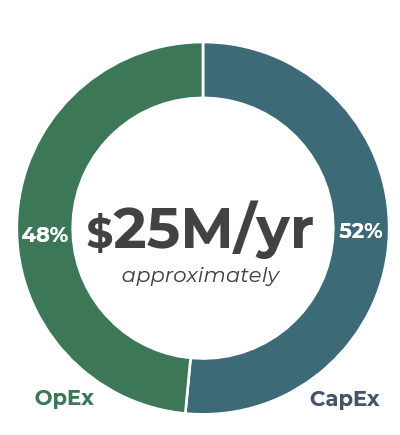
CBS's Electric Utility has an annual budget of approximately $25 million. 48% is operational expenses and 52% capital expenditures. This is not an usual split for electric utilities which. Capital expenditures include debt payments for both the Blue Lake and Green Lake Hydroelectric Projects as well as transmission and distribution upgrades for the substations. Operational expenses include maintenance, insurance, and administrative support. You can learn more about rates here:
Energy Economics
|
With current electric loads and generators, a diesel-only utility in Sitka would require about 11 million gallons of fuel each year, adding least $50 million to operating expenses. While some expenses would no longer be applicable, shifting so much of the balance would not allow for investments to be made into infrastructure that would reduce diesel dependence. While Sitka's electric loads would be much less and it would likely operate more efficient generators, grid improvements would be limited to emergency repairs, rates would be significantly higher, and budgeting much less flexible due to fuel price fluctuation. The majority of money would be lost to fuel costs, limiting the Utility's ability to plan, upgrade, and provide power.
|
Levelized Cost
|
Levelized Costs of Energy (LCoE) includes CapEx and OpEx, as well as considerations like efficiency, to calculate a per-unit cost of electricity over the lifetime of a project. How affordable a renewable energy project is is strongly influenced by the cost of the capital expenditure required to invest that technology. Since the input to generate renewable energy (rain, sun, and wind) is free, the majority of the cost is upfront in the form of capital expenditure. Additionally, the technology is often less complex, with some technologies having no moving parts, such as solar panels. While hydroelectric projects have the highest initial capital, they are also the longest lasting (50-100 years) and most reliable. Today, renewable energy sources have a cheaper LCoE than fossil fuel energy sources.
|
|
2025 Global Levelized Cost of Energy (LCoE) of Different Technologies

Data by Lazard. Per-unit costs are calculated globally and includes only the costs of generation, not transmission and distribution and/or other factors that influence the actual rates of a energy technology in any given area.
|
|